

Our Work

Our Work
Our Work testifies, our commitment to excellence.
In India, craft represents both cultural heritage and a vital economic activity, with millions of artisans across rural and semi-urban areas dependent on it.
For the living traditions to flourish, and for artisans to thrive, creativity must intertwine with commerce for existential reality. The rise in domestic and international demand, highlights the increased significance of craftsmanship in shaping contemporary markets and consumer preferences.
It is in this context, under UNESCO RCCH-Il program for select ICH (Intangible Cultural Heritage) units in Handicrafts & Handloom sectors - a gap analysis study was undertaken to systematically assess the structural, market, and capacity-related constraints affecting the sustainability of traditional art and craft-forms across diverse cultural heritages.
The study seeks to identify critical gaps along the sustainability value chain aiming to identify pathways through which diverse craft enterprises can remain culturally rooted while becoming economically resilient.

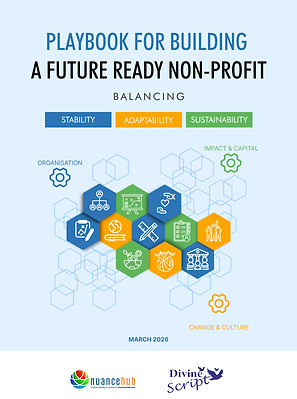
The playbook, designed as a guiding resource for a nonprofit in its transition phase, is developed on a hybrid model framework by drawing directional references from time-tested best practices. It aims to strengthen the organisation’s foundation by ensuring policy compliance, aligning operations with mission-driven outcome goals, enabling adaptability to ecosystem and cultural changes, and fostering stakeholder inclusivity.
The recommendations thereby seek to position the newly formed enterprise entity, to perform better in a new-age, long-term work environment - anchored in internal stability, future ready, resilient to risks, and equipped to create sustainable social value impact.


Done in a three-phase series, the impact evaluations were conducted for Tata Metaliks, in measuring the result performance of CSR intervention projects in thematic areas of - Education, Skill Development, Water and Sanitation, Entrepreneurship and Environment, undertaken by the company to improve the lives of the community people in and around the neighbourhood of their production plant area location of West Medinipur District in West Bengal.
The study applied both quantitative and qualitative research tools upon randomised statistically valid sample size of respondents of beneficiary and stakeholders’ audiences - using indicators to analyse feedback in the Theory of Change result framework.
In summarising the findings, the studies provided recommendation to better address the development challenges in creating sustainable social and environmental values, including showcased examples of best practices evidence proof for replicable reference.

The World Bank funded Jhelum Tawi Flood Recovery Project (JTFRP) was incepted as an emergency support endeavour for natural disaster recovery, in the disastrous aftermath of September 2014 torrential rains in the state of J&K causing Jhelum, Chenab and Tawi rivers as well as many other tributaries flowing above the danger mark, resulting in widespread flooding, landslides and co-lateral damages.
Of the seven JTFRP interventional components identified, restoration and strengthening of local livelihoods was one - under which, handicrafts & handloom sector was chosen for recovery, with the Directorate of Handicrafts & Handloom Kashmir representing the Govt. nodal body for project implementation.
In this sectoral approach, papier-mache’ cluster formed an important part given its contribution to state’s craft economy and livelihood dependence of sizable numbers of artisans from the community.
The cluster livelihood restoration initiative, followed a collective approach, with the implementing partner forming enterprise entity of craft producers, and providing end-to-end hand holding support services for its self-sustaining business growth.
As part of this implementation components, a focussed study was undertaken in-situ to map the organisational readiness and supply-chain resilience as preparatory, in order to recommend and drive revenue growth of the enterprise entity, through multi-pronged strategic marketing input.
As part of HSBC India’s community initiative investment for Women Empowerment through enterprise building in food vending services, a foundational market scoping study was done in cities of Bengaluru, Hyderabad, Gurugram and in more recently in Kolkata.
The city-based studies applied, a mixed mode approach of desk research, ethnographic observation and quantitative surveys of the potential consumers to identify opportunities in terms of 4Ps of marketing – including understanding of consumer’s food preferences, service & need gaps, competitive dynamics etc. helping to craft product propositions with differentiated offerings and take informed decisions in formulating marketing strategies to secure market entry and expansion.
The exercise also curated category insights on supply and demand value chain elements, scope for innovation, technology application and embedding sustainability features in the implementation model.


Adding to the HSBC India’s community initiative program endeavour of Women Entrepreneurship through enterprise led food vending retail - creating a unique brand identity of logo and its various creative expression designs, were undertaken to convey the service’s core essence, values and voice.
So far, two distinct logo renditions paired with corresponding strapline have been created for the entities – Didi’s Meal Box for the markets of Hyderabad, Bengaluru and Delhi NCR and subsequently a separate design unit Heshel for the Kolkata initiative.
A brand style book for each design was alongside developed, in serving as a comprehensive manual to guide consistency and coherence in all brand communication applications across channels and formats.
The guides contained the perspective of logo development philosophy and provided instructions on the use of brand assets like logo, colour palettes, typography and imagery, ensuring that all creative outputs align with the enterprise brand's standards and ethos uniformly.